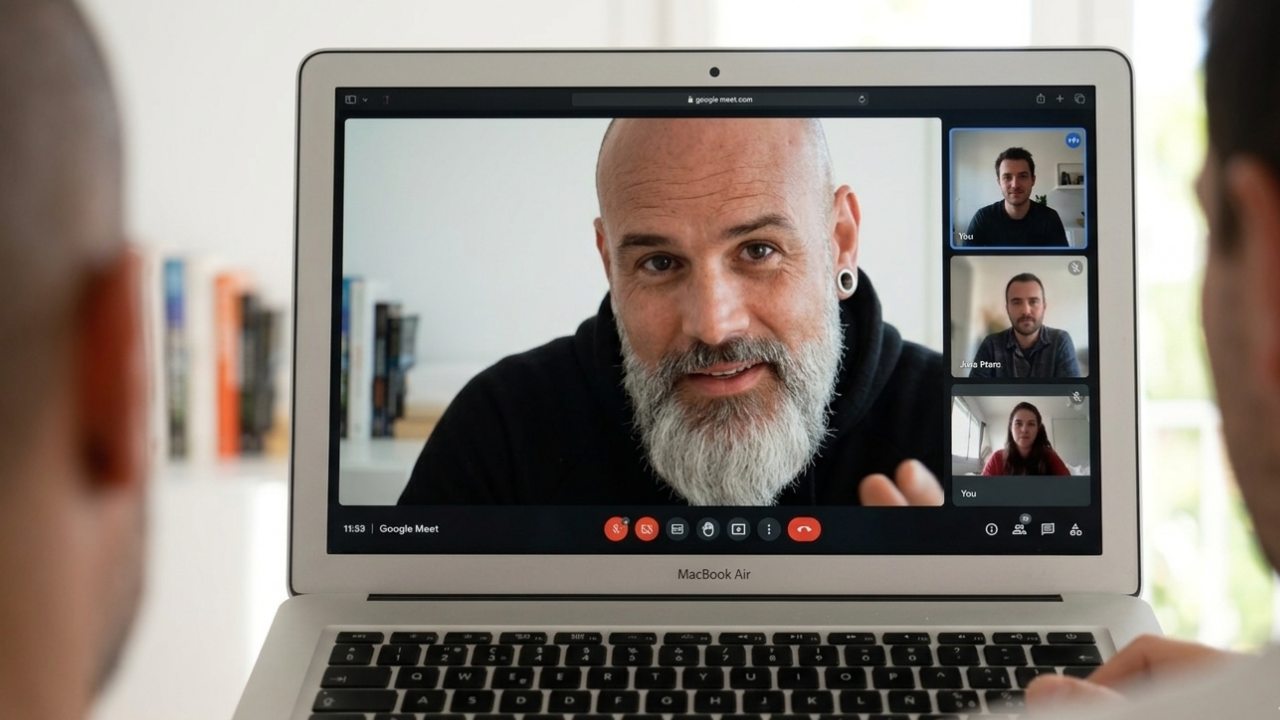
The first time I heard about online hypnotherapy, I thought it was ridiculous.
Someone I knew did a hypnotherapy for smoking course and started seeing clients remotely, over Zoom. My reaction was the same one most people have: how on earth could you hypnotise someone through a screen? Hypnosis, in my head at the time, was still tangled up with the same images most of us grow up with — a swinging pocket watch, a hypnotist’s voice filling a room, someone clucking like a chicken on a stage. It was a very physical, very in-the-room idea of what hypnosis was. The thought of doing it over a video call felt, frankly, like a gimmick.
That changed the moment I actually started studying hypnotherapy myself.
Once you get past the stage-hypnotism stereotypes — which, to be fair, is where almost all of us start, thanks to Hollywood and a handful of TV specials — you realise fairly quickly that hypnosis isn’t really about the room at all. It’s a state you guide someone into through language, pacing, tone, and attention. None of that requires you to be physically present. A huge amount of my own training was delivered online, and by the time I started working with my first real clients, those sessions were online too. It forced me to confront my own assumption head-on, and the assumption didn’t survive contact with the actual process. Hypnosis is a contactless process. There’s no laying on of hands, no physical technique being performed on the client. It’s entirely built on voice and verbal guidance, which travels down a Zoom call exactly as well as it travels across a room.
What actually surprised me, once I’d worked with clients both in person and remotely, wasn’t that online sessions were “almost as good.” In a lot of cases, I found the opposite of what I expected. Clients sitting in their own home, in their own chair or bed, with their own environment around them, often dropped into a more comfortable and noticeably deeper trance than clients did in a clinic room. There’s no drive over, no waiting room, no unfamiliar chair. They’re already in the place where they feel safest, which turns out to matter more for hypnosis than physical proximity to the practitioner ever did.
It turns out the research backs this up, and it goes back further than I expected.
A 2019 study in the International Journal of Clinical and Experimental Hypnosis compared Skype-delivered hypnotherapy against face-to-face treatment for irritable bowel syndrome, one of the conditions with the strongest evidence base for hypnotherapy generally. Patients treated over Skype saw a 65% response rate, compared with 76% for a face-to-face patient audit — both showing statistically significant, clinically meaningful improvement, with the remote group achieving results well within the range of in-person care.
A 2023 paper in the same journal, titled “The Emerging New Reality of Hypnosis Teletherapy,” reviewed how far the field had shifted, reporting that roughly 60% of practising hypnotherapists now offer sessions by video call, with the large majority describing outcomes comparable to their in-person work.
More recently, a 2024 pilot study looked at telehealth-delivered hypnotic cognitive therapy for chronic pain in people with spinal cord injuries, and found reductions in pain intensity, depression, and pain catastrophizing that were statistically indistinguishable from historical in-person controls.
This mirrors what’s been found in psychotherapy research more broadly. A large meta-analysis of videoconference-delivered psychotherapy, pooling results across thousands of clients, found treatment effects that were largely equivalent to in-person delivery. A 2024 systematic review of telehealth versus in-person care reached a similar conclusion: the differences between the two, across a wide range of conditions, were generally small and often not clinically meaningful.
None of this means online hypnotherapy is automatically right for everyone, or that there’s no value in sitting across from someone in person. But my own experience, and the research alongside it, point the same direction: hypnosis was never really about the room. It’s about the state of mind you help someone reach, and for a lot of people, their own home turns out to be the easiest place to get there.
Sources:
- SKYPE HYPNOTHERAPY FOR IRRITABLE BOWEL SYNDROME: Effectiveness and Comparison with Face-to-Face Treatment (Int’l Journal of Clinical and Experimental Hypnosis, 2019)
- The Emerging New Reality of Hypnosis Teletherapy: A Major New Mode of Delivery of Hypnotherapy and Clinical Hypnosis Training (2023)
- The efficacy, safety, and satisfaction of telehealth-delivered hypnotic cognitive therapy for chronic pain in spinal cord injury: a pilot study with historical controls (2024)
- Effectiveness of telehealth versus in-person care during the COVID-19 pandemic: a systematic review (npj Digital Medicine, 2024)
- Videoconferencing in psychiatry, a meta-analysis of assessment and treatment
- The Effectiveness of Online Hypnotherapy: Skype and Zoom Hypnotherapy Sessions