Public Figures Who Used Hypnosis
Hypnosis has a reputation problem — stage acts and pocket-watch clichés make it easy to dismiss. But behind the scenes, a surprising number of history’s biggest names have turned to hypnosis, self-hypnosis, or autosuggestion at pivotal moments in their careers, and several have talked about it openly. Ordered roughly by fame, here’s a look at some of the most well-known cases.
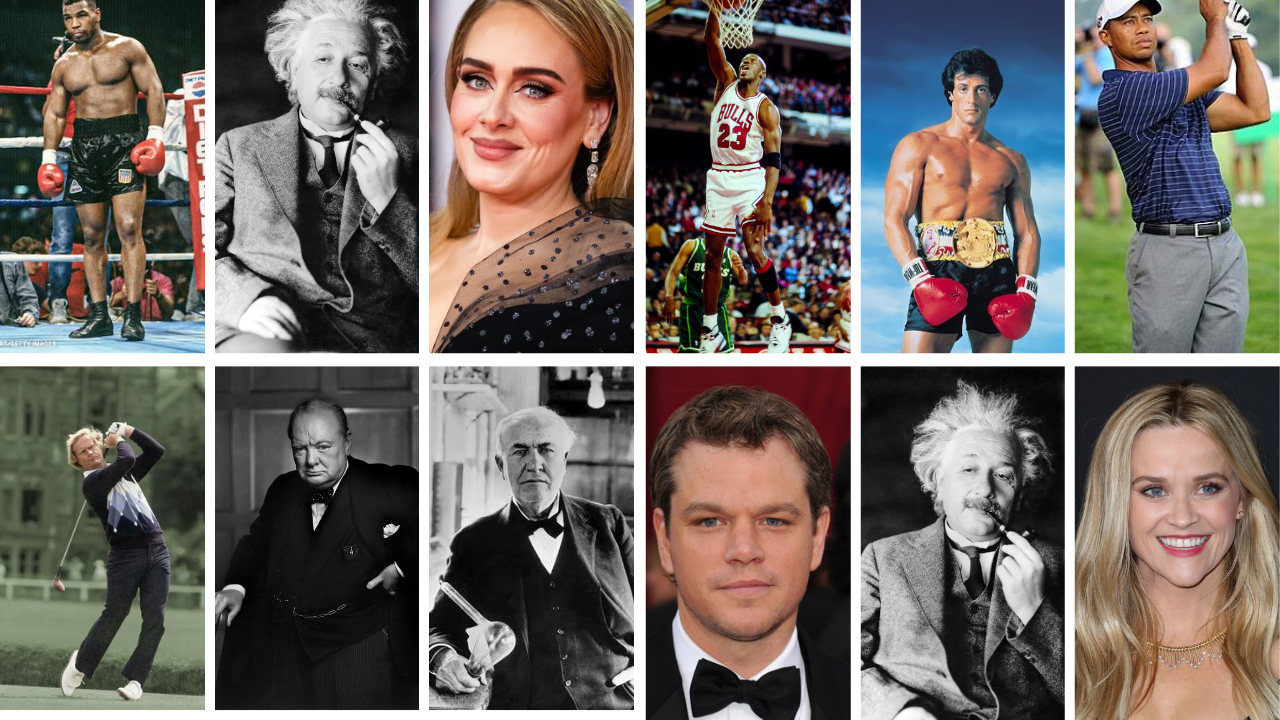
Albert Einstein. It’s a frequently told story in hypnosis circles that Einstein used a form of daily self-hypnosis or deep trance state to step outside conventional thinking, and that some of his breakthrough insights arrived while his mind was in that loosened, non-linear state. This is more legend than court record — but it fits a pattern historians do take seriously: Einstein was known to value unstructured, semi-conscious thinking (violin breaks, walks, daydreaming) as part of how he worked through problems.
Winston Churchill. Hypnosis historians and writers frequently cite Churchill as someone who used post-hypnotic suggestion to fight off exhaustion and keep functioning through the punishing, sleep-deprived stretches of the Second World War. The claim is widely repeated in hypnosis literature, if less rigorously documented than some of the other examples on this list, and it’s often paired with the broader observation that Churchill was a devoted practitioner of deliberate, restorative rest — including his famous daily naps.
Muhammad Ali. After a stunning 1973 upset loss to underdog Ken Norton, who had used hypnosis training to prepare for the fight, reports say Ali began incorporating hypnosis into his own training and mental preparation for future bouts.
Michael Jordan. Widely reported in sports and hypnosis circles alike, Jordan is said to have used hypnosis and visualization techniques to build mental stamina and stay locked in during high-pressure playoff games across his championship run with the Chicago Bulls.
Sigmund Freud. Before he founded psychoanalysis, Freud built his early clinical career on hypnosis. He studied under neurologist Jean-Martin Charcot in Paris and worked alongside Josef Breuer treating patients with hysteria through hypnotic suggestion. Freud used hypnosis in his own practice throughout the late 1880s and into the 1890s before moving on to develop the talking-cure methods that would make him famous — but hypnosis is where his career, and modern psychotherapy itself, effectively began.
Mike Tyson. This one comes straight from Tyson himself, not secondhand reporting. His legendary trainer Cus D’Amato started having him professionally hypnotized at 12 or 13 years old, before sparring, before training, and before fights. Tyson has described the sessions in interviews: he’d relax, focus on nothing but blackness, and the hypnotist would repeat suggestions — that he was “a savage, an intelligent animal,” that he’d fight “both hands to the body” in “ferocious fashion.” Tyson has said D’Amato never taught him how to turn it off, and that the conditioning stuck with him for the rest of his life. Of everyone on this list, Tyson gives one of the most detailed, on-record, first-person accounts of what the hypnosis sessions actually felt like.
Thomas Edison. The inventor famously napped in a chair holding a steel ball over a metal pan. As he drifted toward sleep, his grip would loosen, the ball would clatter to the floor, and the noise would jolt him awake — right at the hypnagogic threshold between waking and sleep, where he believed his best ideas surfaced. Modern sleep researchers have since tested the technique and found it really does boost creative problem-solving.
Sylvester Stallone. In the mid-1970s, Stallone was an unknown actor who’d spent a decade struggling to break into Hollywood. Hypnotherapist Gil Boyne worked with him as he wrote the “Rocky” script, using self-hypnosis to help unlock his drive and creativity. Stallone later said he used subconscious motivation recordings made for him during the Philadelphia location shoot, stretching out and playing them before scenes to calm his nerves. Six months after starting, he had a finished script — and a film that would define his career.
Salvador Dalí. The surrealist painter used a near-identical trick to Edison’s that he called “slumber with a key,” holding a heavy key over a plate as he dozed in a chair. The clatter of the falling key would snap him back to consciousness just as hypnagogic imagery began to surface, which he’d then funnel straight into his paintings.
Adele. After losing her voice completely in 2011 and undergoing throat surgery, Adele was warned that smoking could end her singing career for good. In 2015, after roughly five failed attempts to quit on her own, she spent a session with London hypnotherapist Max Kirsten, known for working with a number of celebrity clients on smoking cessation. She later told Rolling Stone she’d finally kicked the habit, framing it as a decision she made for her health and for her son.
Tiger Woods. Woods began working with sports psychologist Dr. Jay Brunza at age 13. Brunza, a family friend, used mental training techniques that included hypnosis and subliminal audio to help the young golfer manage pre-tournament anxiety and block out crowd distractions. Reports on Woods’s early career describe this training as part of how he learned to visualize each shot before playing it — a skill widely credited with helping him perform under pressure throughout his professional career.
Ellen DeGeneres. DeGeneres underwent an on-camera hypnosis session with British hypnotist Paul McKenna during a 2006 episode of her talk show as part of a public attempt to quit smoking. She later said other methods also played a role in her finally quitting for good, but the session remains one of the more widely watched examples of hypnosis used on a public stage.
Matt Damon. Damon has discussed trying hypnotherapy as a method to quit smoking, joining a long list of actors who turned to the technique rather than nicotine replacement products or willpower alone.
Reese Witherspoon. Ahead of playing Cheryl Strayed in “Wild,” a role that required her to portray a woman working through grief and personal doubt on a solo hike, Witherspoon has said she used hypnosis to help quiet her own insecurities and get into the headspace the part demanded.
Richard Branson. Before attempting a round-the-world hot air balloon journey, an undertaking with real physical danger, Branson used hypnosis as part of his preparation to manage stress and stay focused under pressure.
Jack Nicklaus. One of golf’s most decorated players, Nicklaus has spoken about using visualization techniques closely related to self-hypnosis throughout his career, describing a mental rehearsal process in which he pictured the ball’s flight and landing before every shot. He’s credited this focused, trance-like preparation with sharpening his concentration on the course.
Mary Lou Retton. At the 1984 Olympics, Retton competed on an injured foot. She has credited hypnosis with helping her manage and mentally block the pain during competition, a mental strategy that coincided with her historic all-around gold medal win — the first for an American woman in gymnastics.
Aldous Huxley. The “Brave New World” author spent nearly a year working directly with pioneering hypnotherapist Dr. Milton Erickson in the early 1950s, exploring deep hypnotic and altered states of consciousness together. Their sessions were documented well enough that Erickson published an academic paper on the collaboration, “A Special Inquiry with Aldous Huxley into the Nature and Character of Various States of Consciousness,” making Huxley one of the most rigorously documented hypnosis subjects on this entire list.
Napoleon Hill. The author of “Think and Grow Rich,” one of the best-selling self-help books of all time, built an entire chapter around autosuggestion — instructing readers to read a written statement of their goal aloud twice daily, visualizing themselves already in possession of it. Hill never used the word “hypnosis,” but the technique he taught to millions of readers is functionally self-hypnosis, and it’s still cited today as one of the concept’s most influential mainstream introductions.
Fergie. The singer has spoken about using hypnotherapy to help reshape her relationship with food and support healthier eating habits.
Aaron Eckhart. The actor has said hypnosis played a role in helping him quit both smoking and drinking, calling the shift a turning point for his health and his career.
Some of these accounts, especially the older ones, are more folklore than footnote — repeated so often in hypnosis writing that it’s hard to trace them back to a primary source. Others, like Tyson’s own interviews, Huxley’s documented work with Erickson, or Freud’s clinical record, are as close to verified history as this subject gets. Either way, the throughline holds: for well over a century, some of the sharpest, most driven minds and biggest names in the world have reached for the same tool — a quiet, focused state where the usual mental noise drops away and something new gets through.
Sources:
- Celebs Who Have Used Hypnosis To Advance Their Careers
- 30 Celebrities Who Used Hypnosis to Quit Smoking, for Childbirth and Much More
- A-List Celebrities Who Have Used Hypnosis
- Famous People Who Used Hypnosis – Doc Hypnosis
- Singer Adele quits smoking with hypnotherapy to save her throat
- Adele reveals she quit smoking because she was afraid she might die
- Be Like Mike… or Tiger… or whoever!
- Tiger Woods’ Secret to Success on The Golf Course: Hypnosis
- Famous Athletes and Teams Who Have Used Hypnosis
- The Bizarre Lengths Ellen DeGeneres Went To To Stop Smoking – Nicki Swift
- Discover How Ellen DeGeneres was Able to Stop Smoking for Good
- How Gil Boyne helped Stallone become Rocky Balboa
- Rocky and hypnosis – Katherine Bassford
- Hypnosis and Awareness Expansion: The Case of Aldous Huxley
- A Special Inquiry with Aldous Huxley into the Nature and Character of Various States of Consciousness (American Journal of Clinical Hypnosis)
- Spark Creativity with Thomas Edison’s Napping Technique – Scientific American
- Edison and Dali’s “creative nap” trick seems to actually work
- Salvador Dalí: Hypnagogic Hallucinations in Art – Sleep Health Journal
- Nap Like Salvador Dali – Art of Manliness
- Think and Grow Rich: Chapter 4, Auto-Suggestion
- Autosuggestion and Hypnosis according to Napoleon Hill
- Hypnosis and Catharsis in Freud
- Sigmund Freud and Emile Coué – Hypnosis in History
- Famous Users of Sports Hypnosis – Pete’s Mental Gym
- Mike Tyson: Trainer Cus D’Amato Used to Have Me Hypnotized as Teenage Fighter – Bleacher Report
- Mike Tyson on surprising technique he used before every fight – Yahoo Sports
- Mike Tyson Explains How Cus D’Amato Hypnotized Him – EssentiallySports